Written by Ryan, Year 12 Work Experience
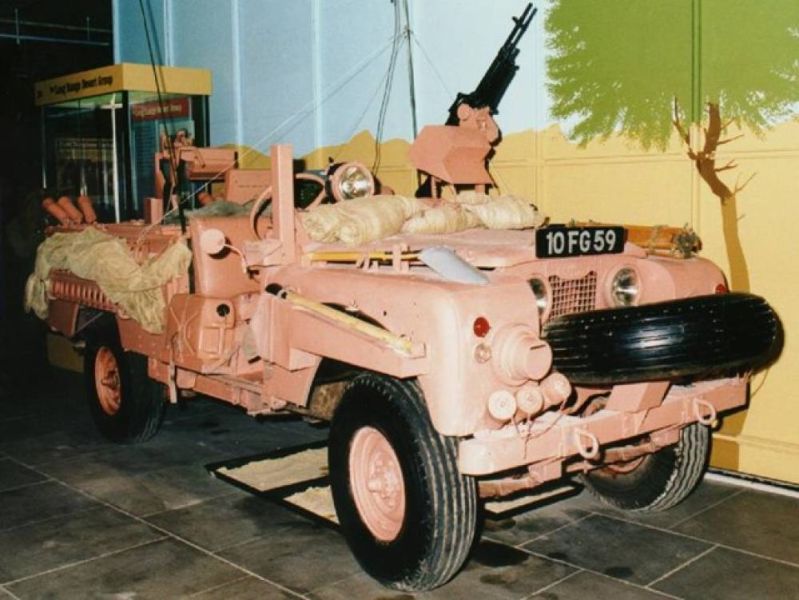
I have been working at the Royal Signals Museum for a week, during my time I have been working with the medal collection. I have a key interest in the Pink Panther Land Rover exhibit, this is because of the unusual nature of the colour and the importance it had when patrolling the desert.
The British Army have been using heavy vehicles in combat for years, however the origin of using a Land Rover for desert patrols came about in 1968, when the British Ministry of defence bought 72 Land Rovers – long wheelbase version. They were bought as a vehicle a which was still able to be a 'tough' heavy machine, when patrolling the deserts.
The Land Rover's design is heavily based of the Jeep, which was frequently used in WW2, however, the SAS needed a vehicle that could 'blend in with its surroundings.' They noticed that the desert haze had a pinkish colour; therefore, they painted the vehicles pink as a form of camouflage when patrolling in the Gulf desert and the deserts of Aden. The Pink Panther Land Rover was born. The SAS modified the Land Rover even more, by removing all the doors, adding sand tyres and adapting it to be a Series 2 Land Rover, meaning it would have a better durability and off-road experience, which was needed in the desert. The vehicle (when on the road) had a max speed of 100km/h and was given the name 'The Pink Panther' to mark the strange colour choice. While the operators of the vehicle were given two nicknames, either 'the Pink Panthers' or 'Pinkies.'
From afar the pink camouflage would blend into the haze, from above the pink would resemble a reflection from the sun and sand, ultimately confusing the enemy. However, up close some may assume it was to be mirage, due to the high heat of the sun. The vehicle was equipped with both communications’ equipment and heavy firearms.
Many radios were added to the vehicle to ensure good communication. A radio set A43R was added to the vehicle, operating at an ultra high frequency, also being used as a beacon for aircrafts to home in on signals. The radio set had a 40-mile radius and was able to work from 30,000 feet once used in the air. Whereas the heavy firearms were used for more military purposes. Along the side of the Land Rover, rifle boxes and ammunition crates were attached, with a general-purpose machine gun, (GPMG) this weapon would be used by the commander (who would also operate as the navigator). The machine would be placed on a moveable pad, so they use the weapon in any angle needed.
Most of the 72 original Land Rovers didn’t survive their time in the desert. Approximately 20 survived in museums or collections, one of which is in the Royal Signals Museum. The pink camouflage was an incredible concept that was executed perfectly, with many replicas (and ideas similar) being made today.